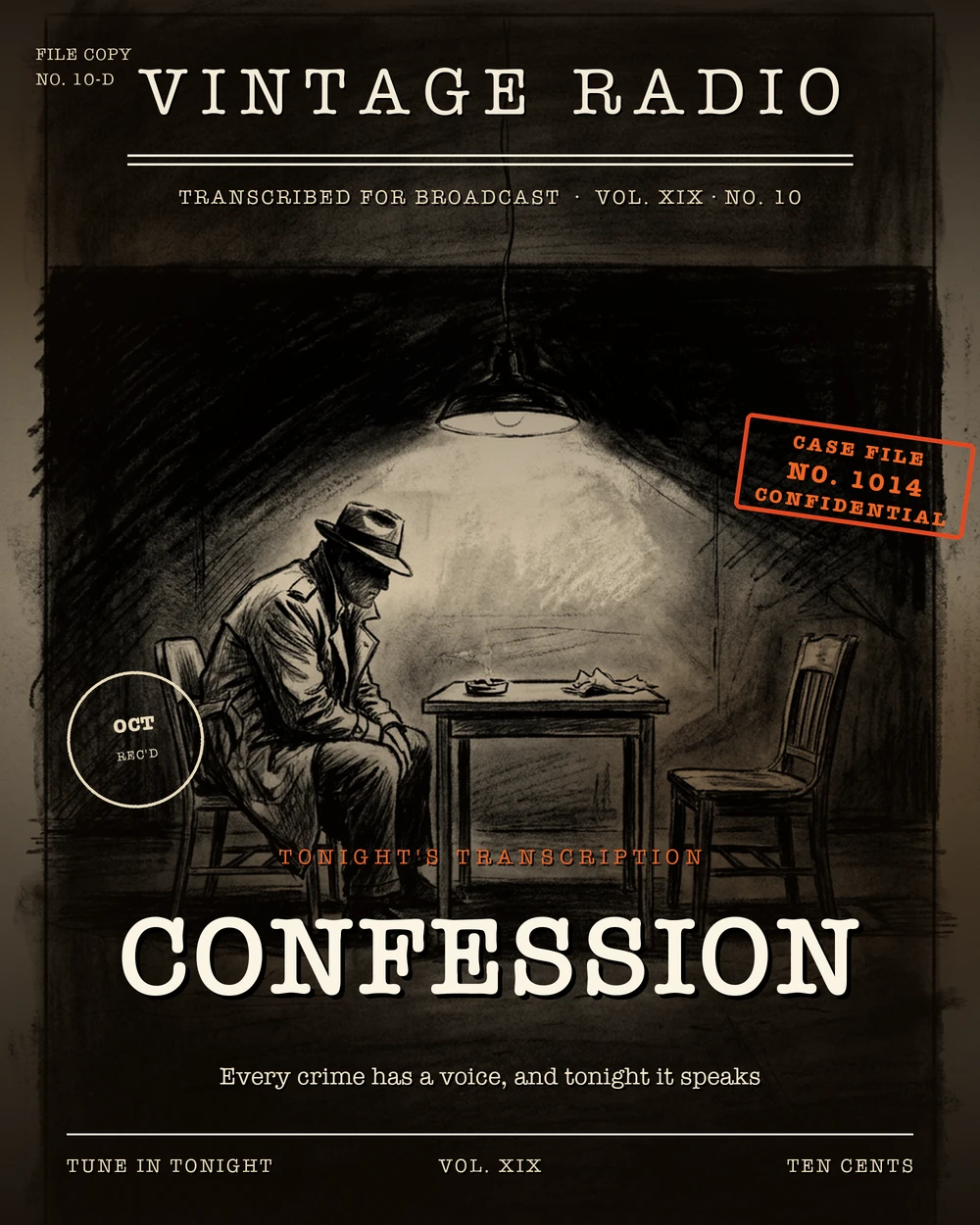
Confession
Dragnet in Reverse
Confession arrived on NBC in the summer of 1953 as a Sunday-night replacement for Dragnet, and the family resemblance was hard to miss. The texture and sound ran along similar lines — deadpan dialogue, documented true crimes, a procedural feel that kept things grounded. But the show had one structural idea that set it apart: it started at the end. Where Dragnet opened with a crime and moved toward an arrest, Confession opened with the confession already given. The criminal spoke first, and the story worked backward.
Each episode opened with a scripted exchange. The criminal stated: "I make this confession of my own free will because it is true. There wasn't any force or violence used upon my person to induce me to make these statements. Without promise of immunity or gratuity, I confess." Announcer John Wald answered: "You are listening to Confession. This confession is a matter of documented record. You will hear the story of this crime experience in the person's own words." From there, the criminal functioned as a stream-of-consciousness narrator, the action cutting away into dramatized scenes. By the end, a capsule summary told the results of the trial — identified as taking place "in the Superior Court, State of California, in and for the Country of Los Angeles" — even though the series drew on corrections files from across the United States.
The show was quieter than Dragnet. The theme music ran on a single piano. Confessions were delivered with resignation and defeat rather than defiance, spoken — as one OTR commentator later noted — "with unpretentious, unembellished language." Actors were directed to cough, occasionally mumble, and be interrupted by the interviewer, pushing the documentary realism as far as it would go. Names were changed "to protect the legal rights of the subject," and one key difference from Dragnet was that Confession actually dramatized the commission of crimes — something Dragnet almost never did.
The People Behind It
Producers Warren Lewis and Homer Canfield built the show, with Canfield also directing. Scripts came from Don Brinkley, Richard Allen Simmons, and Lou Rusoff. The casting drew from the working pool of Hollywood radio character actors — experienced voices who could handle documentary dialogue without pushing it into melodrama.
Paul Frees played the recurring role of Richard A. McGee, director of the California State Department of Corrections, in every episode. The real Richard McGee appeared midway through each broadcast to remind listeners that "Crime does not pay" — a public-service moment reinforcing the show's framing as something more than entertainment. NBC presented the series as a sustaining broadcast, unsponsored, closing each episode with the statement that it was "brought to you each week by NBC in an effort to stem the nation's forward march of crime."
The supporting cast across the run included Virginia Christine, Herb Butterfield, Jonathan Hole, Don Diamond, Jack Moyles, Peter Leeds, Parley Baer, Barney Phillips, Virginia Gregg, Stacy Harris, Marvin Miller, Gerald Mohr, Lurene Tuttle, and Les Tremayne, drawn from the same deep bench of Los Angeles radio talent.
The Cast Worth Knowing
Frees, born Solomon Hersh Frees in Chicago on June 22, 1920, had an unusual path to radio. He started in vaudeville as an impressionist billed as "Buddy Green," moved into radio work in 1942, was wounded at Normandy on D-Day, and spent a year recuperating before resuming his career. After the war he attended the Chouinard Art Institute in Los Angeles on the G.I. Bill, but left when his first wife's health deteriorated and returned to the microphone. His natural baritone drew frequent comparisons to Orson Welles, earning him the informal tag "The Man of a Thousand Voices." Other prominent radio roles included the title character of The Green Lama on CBS in 1949 and the lead of the syndicated anthology The Player in 1948, in which he voiced every character. He was posthumously honored as a Disney Legend in 2006 for his work with Walt Disney Studios, including the voice of Professor Ludwig Von Drake.
Virginia Christine, born Virginia Christine Ricketts on March 5, 1920, in Stanton, Iowa, began her radio work as a teenager in Chicago and continued it at UCLA. She was married to character actor and director Fritz Feld from 1940 until his death in 1993, and became a frequent collaborator of Stanley Kramer, appearing in six of his films including High Noon (1952) and Guess Who's Coming to Dinner (1967). Outside radio and film, she's probably best remembered for a 21-year run as "Mrs. Olsen" in Folgers Coffee television commercials that began in 1965 — a role so associated with her that Stanton, Iowa eventually converted its water tower into a giant coffeepot in her honor. She died in Brentwood, Los Angeles, on July 24, 1996.
A Short Run, Documented
Confession ran from July 5 to September 13, 1953 — ten weeks on Sunday nights at 9:30. Eight episode titles are documented from the original run, beginning with "The Doris Kane Case" on July 5 and including "The Martin Everett Case," "The Anna Carlson Case," and "The Esther Phillips Case," among others. A ninth, "The Peter W. Greer Case," is dated August 9, 1953. Around ten recordings survive in total. When Dragnet returned in the fall, Confession stepped aside without ceremony. It had done what a summer replacement was supposed to do, and done it with a structural twist that, for those ten weeks, made Sunday nights at 9:30 worth paying attention to.